domingo, 30 de octubre de 2011

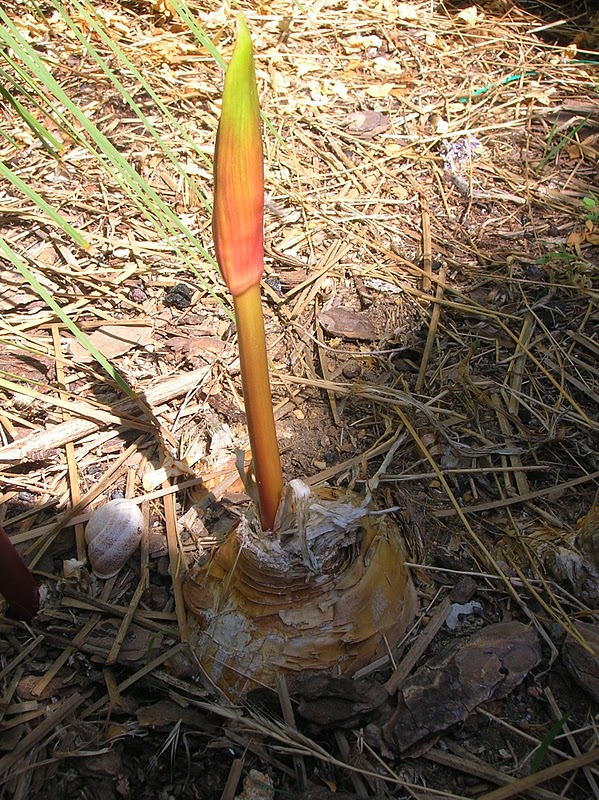
NEODYPSIS DECARYI


NEODYPSIS DECARYI  (sin. Dypsis Decaryi)

Origen: Madagascar

Esta palmera, que no suele desarrollar un tronco de más de 2 metros de altura, coronado por frondas de hasta 3,5 metros, tiene como característica principal que la base de donde nacen las frondas, o sea la parte superior del tronco, tiene forma triangular, de ahí su nombre popular de "palmera de tronco triangular". Las frondas crecen en un ángulo de unos 45ª con respecto al tronco. Cuando la palmera crece los restos foliares que quedan sobre el tronco contribuyen a intensificar esa apariencia de tronco triangular.

Es una palmera de crecimiento moderado y más bien lento.

A pesar de su origen tropical resiste heladas débiles si no son muy prolongadas.


English version:
Origin: Madagascar
Common name: Three-cornered Palm, Triangle Palm
This palm, that seldom reaches 2 metres high but topped by a vase-like crown of fronds up to about 3,5 metres, gets its name from the bulging leaf or frond bases that grow to form a distinct 3-sided triangle. Normally the fronds are held upright at no more than a 45-degree angle to the trunk.
It´s a slow growing palm.
In spite of its tropical origin it withstands light  frosts if they´re short.

sábado, 29 de octubre de 2011

¿UNA CYCA DE CRECIMIENTO RAPIDO?


¿UNA CYCA DE CRECIMIENTO RAPIDO?

Parece que sí. Cycas rumphii, a pesar de su origen tropical,  ha crecido apreciablemente en los cinco años que separan estas dos fotografías. Además este año nos ha dado dos coronas de nuevas hojas, una pequeña al principio del verano y otra más grande a principios de otoño.

Para ver más fotos de esta planta, pincha aquí.


A fast growing cycad?

It loos like as that. Cycas rumphii, in spite of its tropical origin, has grown a lot in the last five years as you can see in the pictures. This year it has given us two crowns of leaves, a little one at the beginning of summer and a big one at the beginning of fall.
To see more pictures of this plant, click here.

domingo, 23 de octubre de 2011

BISMARCKIA NOBILIS


BISMARCKIA NOBILIS

Origen: Madagascar

La Bismarckia es probablemente una de las palmeras más bonitas. Tiene grandes hojas en forma de abanico de color gris azulado. Puede alcanzar 15 metros de altura.

Es una palmera tropical. Su resistencia al frío es limitada, aunque en Recregarden ha soportado heladas débiles sin problemas. Su crecimiento es muuuuy lento. Al menos aquí.


English version:
Origin: Madagascar
Common name: Bismarck Palm
Bismarck Palm is one of the most beautiful palms. It has big fan shaped bluish leaves . It can reach 15 metres tall.
It´s a tropical palm. Its cold hardiness is limited although here in Recregarden it has withstood light frosts without problems. It´s a veeery slow growing palm (at least here).

lunes, 17 de octubre de 2011

PHASEOLUS CARACALLA (Actualización)


PHASEOLUS CARACALLA  (Actualización)


Nuestra primera Phaseolus murió hace tres inviernos. El otoño pasado plantamos otra en un lugar más protegido y os muestro las fotos de su floración veraniega. Para ver más fotos pincha aquí.

Our first Phaseolus died three winters ago. Last fall we planted another one in a more sheltered place. Here you have some pictures of its summer blooming. To see more pictures click here.

domingo, 16 de octubre de 2011

CUPHEA IGNEA


CUPHEA IGNEA  (sin. Cuphea platycentra)

Origen: México, Centroamérica y Norte de Sudamérica

Es un subarbusto que alcanza unos 40 cm de altura.

Recibe el nombre de planta del cigarro o fosforito por la forma de sus flores con la punta de color grisaceo lo que recuerda la ceniza de un cigarro.

Se reproduce por esquejes.

Sólo soporta heladas débiles.


English version:
Origin: Mexico and West Indies
Common name: Cigar Flower, Cigarette Plant
It´s a subshrub that grows to 40 cm tall.
Its common name is dued to the resemblance of the flowers wit a cigarette, tubular with a grey tip suggesting the ash at the tip of a cigar.
Propagation is by cuttings.
It withstands only light frosts. 

domingo, 9 de octubre de 2011

KALANCHOE MILLOTII


KALANCHOE MILLOTII

Origen: Madagascar

Es un subarbusto suculento que puede alcanzar 30 cm de altura.

Se reproduce fácilmente por esquejes.

Sólo soporta heladas muy débiles.


English version:
Origin: Madgascar
Succulent subshrub up to 30 cm tall.
Propagation is easy by cuttings.
It withstands only very light frosts.

domingo, 2 de octubre de 2011

XANTHOSOMA SAGITTIFOLIUM (Actualización)


XANTHOSOMA SAGITTIFOLIUM  (Actualización)

Nuevas fotos de esta planta. Para verlas pincha aquí.

New pictures of this plant. To see them click here.

sábado, 1 de octubre de 2011

THEVETIA PERUVIANA


THEVETIA PERUVIANA (sin. Thevetia neriifolia)

Origen: México y América tropical.

La thevetia es un arbusto o pequeño arbolito que, en sus lugares de origen, produce flores amarillas durante casi todo el año. En Recregarden tenemos otra variedad que produce flores de color naranja pálido, conocida como "apricot". (Para ver su ficha pincha aquí)

Es pariente de la adelfa. En inglés es conocida como "adelfa amarilla".

La savia y las semillas de esta planta son venenosas. Las semillas contienen un estimulante cardiaco usado en medicina tradicional. También se usan como amuleto o para guardarlas en el bolsillo creyendo así evitar las hemorroides. También se está testando su uso como insecticida, fungicida e incluso raticida biológico.

Se reproduce por semillas y esquejes.

Sólo soporta heladas débiles.


English version:
Origin: Mexico and tropical America
Common name: yellow oleander, lucky nut
It´s a shrub or little tree which, in its native habitat, flowers all year around with yellow flowers. In REcregarden we have another cultivar called "apricot" with soft orange flowers. (To see its profile click here)
It´s a relative of oleander (Nerium).
The sap and the seeds are poisonous. The seeds contain a heart stimulant used in tradicional medicine. The plant's toxins have tested in experiments for uses in biological pest control. 
Propagation is from seeds or cuttings.
It withstands only light frosts.


Actualizado a 19/10/2012

domingo, 25 de septiembre de 2011

CYATHEA MEDULLARIS


CYATHEA MEDULLARIS

Origen: Nueva Zelanda, Fidji y Polinesia

Es uno de los helechos arbóreos más grandes pudiendo alcanzar 15 metros de altura (por supuesto en sus hábitats de origen).

Es también uno de los más atractivos por el color negro de los peciolos de las frondas, de ahí su nombre común de helecho arbóreo negro.

Desafortunadamente no arraigó en Recregarden. Nuestros veranos son demasiado calurosos y secos.


English version:Origin: New Zealand, Fiji and Polynesia.
Common name: Black Tree-Fern
It´s one of the largest and most robust tree ferns, reaching 15 metres tall (of course in its native habitats).
It´s also one of the most beautiful ones with its black petioles, hence its common name.
Unfortunately it did´t withstood Recregarden hot and dry summers and died.

sábado, 24 de septiembre de 2011

LA "DAMA DESNUDA" ANUNCIA EL OTOÑO


LA "DAMA DESNUDA" ANUNCIA EL OTOÑO

Las flores "desnudas de hojas" de la Amaryllis belladonna surgiendo del suelo anuncian el comienzo del otoño.

Para ver más fotos de esta planta pincha aquí.


The "leaves naked" flowers of Amaryllis belladonna growing from the ground annunciate the beginning of fall.

To see more pictures of this plant click here.

domingo, 18 de septiembre de 2011

COBAEA SCANDENS


COBAEA SCANDENS

Origen: México

Es una trepadora que se cultiva como vivaz de corta vida o como anual en climas templados.

Se multiplica por semillas.

sólo soporta heladas muy débiles.


English version:
Origin: Mexico
Common name: Cup and Sauver Vine
It´s a short lived perennial climber often grown as annual in temperate areas.
Propagation is by seeds.
It withstands only very light frosts.

sábado, 17 de septiembre de 2011

CLYTOSTOMA CALLISTEGIOIDES (Actualización)


CLYTOSTOMA CALLISTEGIOIDES  (Actualización)

Nuevas fotos de esta planta. Para verlas pincha aquí.

New pictures of this plant. To see them click here.

domingo, 11 de septiembre de 2011

SELENICEREUS TESTUDO ???


SELENICEREUS TESTUDO  ???

Origen: Centramérica, desde el sur de México hasta Colombia

No estoy seguro sobre la especie. Cuando lo compré venía etiquetado como Hylocereus guatemalensis, lo que es incorrecto. Creo haberlo identificado como Selenicereus testudo.

Es un cactus epífito que produce (no en Recregarden) grandes y olorosas flores blancas. Al parecer produce pequeños frutos comestibles, de ahí su nombre de pitahaya (ver Hylocereus undatus) de tortuga.

Se reproduce bien por esquejes.

No soporta las bajas temperaturas. El pasado invierno no hubo heladas (la temperatura más baja fue de 2,5ºC) y aún así la planta sufrió graves daños y pensé que no sobreviviría. De hecho aún no se ha recuperado plenamente.


English version:
Origin: Central America, from Southern Mexico to Colombia
Common name: Dog-tail Cactus, Pitahaya de tortuga.
I´m not sure about the species. I bought it lavelled as Hylocereus guatemalensis what was evidently wrong. I think I´ve identified it as Selenicereus testudo.
It´s an epiphytic cactus that produces (not in Recregarden) big scented white flowers followed but little edible fruits, since its common name Pitahaya (see Hylocereus undatus) de tortuga.
Propagation is easy by cuttings.
It doesn´t withstand low temperatures. Last winter there were no frosts (lowest temperature was 36,5ºF) and the plant suffered so big damages that I thought it wouldn´t survive the winter. In fact it hasn´t recovered totally.

domingo, 4 de septiembre de 2011

STANGERIA "RESUCITA"


STANGERIA "RESUCITA"

Las Stangerias son cycas muy primitivas que parecen helechos.

Son plantas que viven mucho pero su crecimiento es muy lento. En algunos casos extraordinaria y desesperantemente lento. Dos Stangerias llegaron a Recregarden en la primavera de 2007 directamente desde su Sudáfrica natal. Una de ellas dio una hoja en su segunda temporada y este verano ha dado la segunda. La otra intentó dar una hoja nada más llegar y luego nada... Parecía muerta. La paciencia es la principal herramienta para cultivar cycas y este verano, cuatro años más tarde, ha resucitado dando su primera hoja. Algo parecido nos sucedió con Encephalartos lehmannii.

Las cycas crecen muy lentamente pero son muy duras de matar... Sed pacientes con ellas.

Para ver más fotos de esta planta pincha aquí.


Stangerias are very primitive cycads that look like ferns.
They are vey long-living plants but its growing its very slowly. Sometimes it´s extremely an even desperately slow. Two Stangerias arrived to Recregarden in 2007 spring directly from its native South Africa. One of them gave a leave in its second season and a second one last summer. The other one tried to give a leave when it arrived and then nothing... It looked like as it was dead. Patience is the main toole to grow cycads and this summer, four years later, it has risen giving us its first leave. Some similar occurred with Encephalartos lehmannii.
Cycads are very slow-growing but very hard to die. Be patient with them.

To see more pictures of this plant click here.