domingo, 16 de noviembre de 2014

PASSIFLORA COCCINEA


PASSIFLORA COCCINEA

Origen: región amazónica de Perú, Brasil y Bolivia, así como Venezuela, Colombia y las Guayanas. 

Trepadora que alcanza los 9 metros de altura, aunque en cultivo raramente supera los 3 ó 4 metros. 

El fruto es comestible, redondeado y con unos 5 cm de diámetro, rayado volviéndose amarillo o naranja cuando madura. 

Sólo soporta heladas muy débiles. 


English version:
Origin: Amazon region of Peru, Brazil and Bolivia, as well as Venezuela, Colombia and the Guianas. 
Common names: Red Passion Flower, Red Granadilla. 
Vine that grows to 9 metres tall, usually no more than 3-4 metres in cultivation. 
The fruit is edible, rounded, 5 cm diameter, striped, becoming yellow or orange when ripe. 
It only withstands very light frosts. 


domingo, 2 de noviembre de 2014

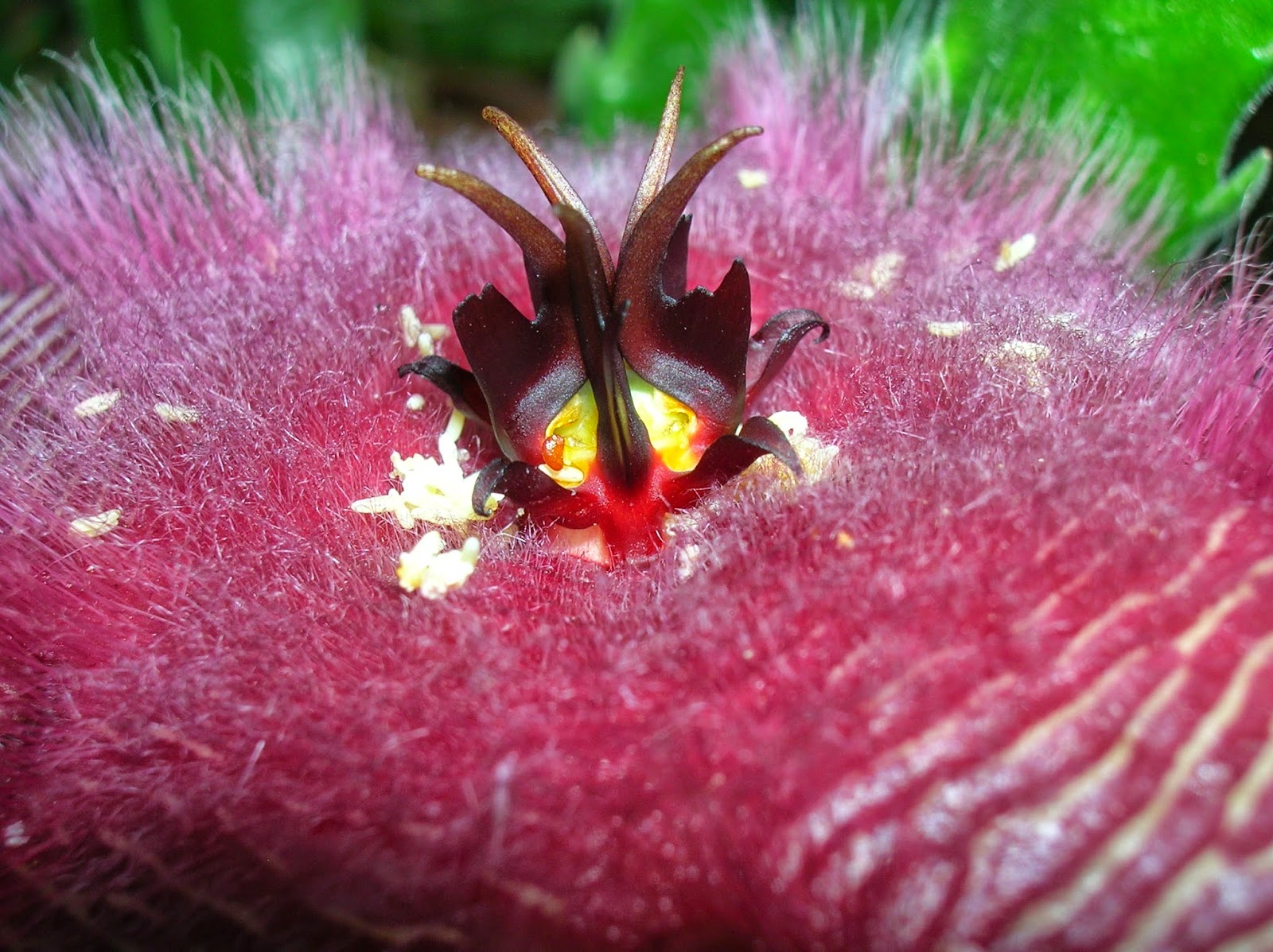
STAPELIA GRANDIFLORA


COMPARACION DE FLORES DE STAPELIA GRANDIFLORA Y GIGANTEA


STAPELIA GRANDIFLORA

Origen: Sudáfrica

Es una pequeña suculenta con tallos de porte erguido o rastrero (idónea para cestas colgantes), que no alcanzan más de 20 cm de altura y que puede formar matas con muchos ejemplares de 50 cm de diámetro o más. 

Las flores de esta especie son más pequeñas que las de su pariente la Stapelia gigantea. (Ver fotos comparándolas) Como todas las flores de esta familia  exhalan un olor desagradable similar a la de carne en descomposición y tienen una textura hirsuta que recuerda a un animal muerto. Esto es así porque son polinizadas por moscas que se sienten atraídas por el aspecto y olor de la flor, llegando incluso a depositar sus larvas en la planta como harían con un animal muerto (larvas que mueren al no poder alimentarse de la flor). 

Se reproduce muy fácilmente por esquejes que deben dejarse secar durante unos días antes de plantarlos.

Soporta heladas débiles con tiempo seco.


English version:
Origin: South Africa
Common names: Carrion Flower
It's a little succulent with upright or semi postrate creeping stems to 20 cm tall. It may form clumps up to 50 cm in diameter or more. 
Flowers of this species are smaller than those of its bigger relative Stapelia gigantea. (See a couple of pictures comparing them). As all the flowers within this family, they are starfish-shaped and are patterned and smell resembling a dead animal to attract the flies which pollinate them. Sometimes the flies even lay their larvae on the flowers but they starve to death as they can't eat the flower. 
Propagation is very easy by cuttings dried off for a few days before planting.
They withstand light frosts with dry weather.


Actualizado a 30/10/2015

domingo, 26 de octubre de 2014

NUEVA Y MASIVA FLORACION DE EPIPHYLLUM PUMILUM


NUEVA Y MASIVA FLORACION DE EPIPHYLLUM PUMILUM


Dos de nuestros "Pumilum" han vuelto a florecer y en una noche nos han regalado más de treinta bellas, pero efímeras, flores. 

Para ver más fotos de esta planta pincha aquí. 


Two of our "pumilum" have bloomed again, showing in a single night more than 30 of their beautiful but short-lived flowers. 

To see more pictures of this plant click here. 


sábado, 25 de octubre de 2014

GAURA LINDHEIMERI


GAURA LINDHEIMERI

Origen: sur de Estados Unidos y norte de México. 

Es una planta herbácea perenne que puede alcanzar algo más de un metro de altura. 

Tolera la sequía y soporta heladas débiles e incluso moderadas. 

Se reproduce por división y semillas. 


English version: 
Origin: Southern USA and adjacent Mexico.
Common names: Whirling butterflies, Butterfly Gaura. 
It´s a herbaceous perennial that grows to one metre tall. 
Tolerant of drought, it withstands light and even moderate frosts.
Propagation is by division or seeds.


domingo, 12 de octubre de 2014

LA "FLOR MURCIELAGO" FLORECE


Este verano llegó a Recregarden la original "flor murciélago" o "bigotes de gato" (Tacca chantrieri), planta tropical nativa del sudeste asiático que no soporta el frío (problema en invierno) ni la falta de humedad ambiental (problema en verano). A pesar de todo nos ha regalado la inflorescencia que mostramos. 

Las bracteas en forma de ala no han adquirido el color marrón oscuro característico y, además, un insecto las mordió (puede verse la diferencia entre las fotos 1 y 2) pero aún así la flor es muy original. 

Este invierno la trasladaremos a un lugar protegido a ver cómo lo soporta...


This summer arrived to Recregarden the strange "black bat flower", tropical plant native to Southeastern Asia. It doesn´t tolerate neither cold (a problem for winters) nor low humidity (a problem for summers). In spite of that it has given us the inflorecence we show. 
The bracts haven´t got their characteristic dark brown color and were bitten by an insect (see differences between pictures 1 and 2) but in spite of that the flower is very strange and original. 
This winter we will take it to a sheltered place to see if it thrives or not... 

sábado, 4 de octubre de 2014

JATROPHA INTEGERRIMA


JATROPHA INTEGERRIMA

Origen: Cuba y Sudamérica

Es un arbusto o pequeño arbolito (si se lo poda adecuadamente) que puede alcanzar 4 metros de altura aunque, normalmente, no supera los 2 metros. 

Normalmente es un arbusto de forma redondeada y con varios troncos pero tolera muy bien la poda por lo que se le puede dar forma de arbolito.

Es sensible a las bajas temperaturas. 

Se reproduce por esquejes en verano. 


English version:
Common names: Peregrina, Spicy Jatropha. 
It´s a shrub or little tree (if pruned adequately) that may reach 4 metres tall (usually no more than 2 metres). 
It´s usually a rounded shrub with multiple slender trunks but it can be pruned to a single one.
It´s sensitive to low temperatures.
Propagation is by cuttings in summer. 

domingo, 28 de septiembre de 2014

HOYA WAYETTI ?


HOYA WAYETTI ??

No estoy seguro sobre la especie. Hoya wayetti y Hoya kentiana son muy parecidas. Según he leído se diferencian porque H. wayetti tiene el borde de las hojas más ocuro y, sobre todo porque H. wayetti tiene los pedicelos o pedúnculos (los rabitos que unen las flores al tallo)  de color verde y H. kentiana de color rosado. 

Hoya wayetti es originaria del norte de la isla de Luzón, en las filipinas. 

Nuestra hoya lleva un par de años creciendo en un porche cubierto orientado al sur y aunque ha intentado florecer varias veces (los capullos se secaban quizás por la falta de humedad ambiental) pero sólo uno de los ramilletes de flores llegó a abrirse (es el que muestro en las fotos). 


English version:
I´m not sure about the species. Hoya wayetti and Hoya kentiana are very similar. I´ve read that H. wayetti has darker leaf margins and, specially, H. wayetti has green pedicels (flower stalks) while H. kentiana has pinkish ones. 
Hoya wayetti comes from the north of Luzon island, in Philippines.
Our hoya lives since a couple of years ago in a sheltered southfacing porch. It has tried to bloom many times (but buds dried up, perhaps due to very low levels of humidity). Just one of the clusters opened (that I show in the pictures).